
Some components require holes that are considerably deeper than their diameter. As drilling depth increases, maintaining hole straightness, chip evacuation, coolant flow, and consistent drilling performance becomes more challenging. For such requirements, specialised deep-hole machining provides a more suitable approach.
Gun drilling is a specialised process used for producing long, narrow holes where controlled drilling performance is important. Selecting the right deep hole drilling machine therefore depends on factors such as hole diameter, drilling depth, component geometry, and production requirements.
What Is a Deep Hole Drilling Machine?
A Deep Hole Drilling Machine is a specialised machine tool designed to produce holes with a high depth-to-diameter ratio. It is used for components that require long, narrow holes or internal passages extending significantly into the workpiece. These machines are available in different configurations to accommodate varying hole diameters, drilling depths, component sizes, and manufacturing requirements.
What Makes Deep Drilling Different?
Deep drilling involves producing holes where the depth is significantly greater in relation to the hole diameter. As the tool travels deeper into the workpiece, chip evacuation and heat management become increasingly important. Tool guidance and maintaining hole straightness can also become more challenging as drilling depth increases.
Gun drilling is specifically suited to these requirements. The process is designed to support deep and narrow hole production while maintaining controlled drilling conditions throughout the operation. This makes it relevant for components where depth, diameter, and repeatable hole characteristics are important.
Applications of Deep Hole Drilling
This type of drilling is used across manufacturing applications involving long, narrow, or controlled internal holes.
- Automotive & Auto Components
Automotive components such as shafts, pins, and other engineered parts may require deep internal holes or passages. Consistent drilling performance becomes particularly important when similar components are produced repeatedly.
- Tool, Die & Mould Manufacturing
Tooling and mould components can require deep holes for cooling passages and other internal features. Controlled hole depth and straightness can be important when these passages influence the performance of the finished tool or mould.
- Hydraulics & Pneumatics
Hydraulic and pneumatic components may involve internal passages requiring controlled depth and dimensions. Deep-hole machining can be used where long internal holes form part of the component design.
- General Engineering & Machine Components
General engineering involves components with different sizes, materials, and machining requirements. Gun drilling can be considered for engineered components that require deep, narrow holes with consistent drilling results.
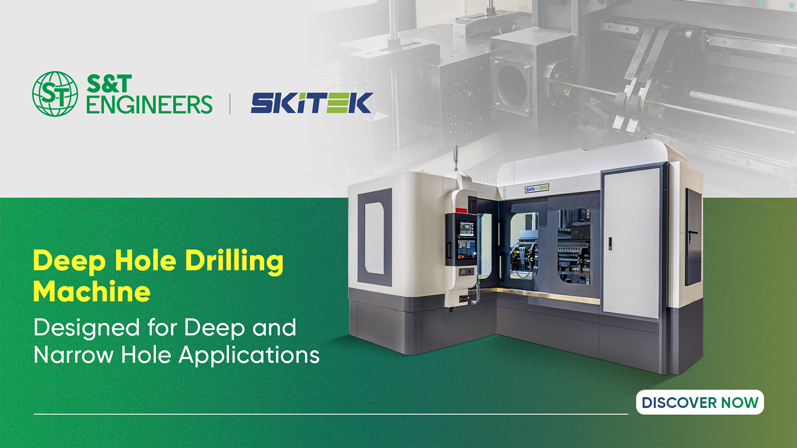
SKITEK 3-Axis Deep Hole Drilling Machine
The SKITEK 3-Axis Deep Hole Drilling Machine, model SK-N-1300, is developed for applications requiring deep and narrow holes across a range of component types. It supports drilling diameters from 2.5 mm to 30 mm and drilling depths up to 1300 mm.
Its 3-axis configuration provides controlled movement during the drilling process, making it suitable for manufacturers handling specialised drilling requirements across different production environments.
Why a Dedicated Solution Matters
When long and narrow holes are a recurring part of component manufacturing, equipment designed specifically for these requirements can provide a more suitable machining approach. A dedicated solution allows manufacturers to address the challenges associated with drilling depth, small diameters, hole characteristics, and repeatable production more effectively.
Planning Your Next Deep-Hole Application?
Explore the SKITEK 3-Axis Deep Hole Drilling Machine and discover its capabilities for your application.