
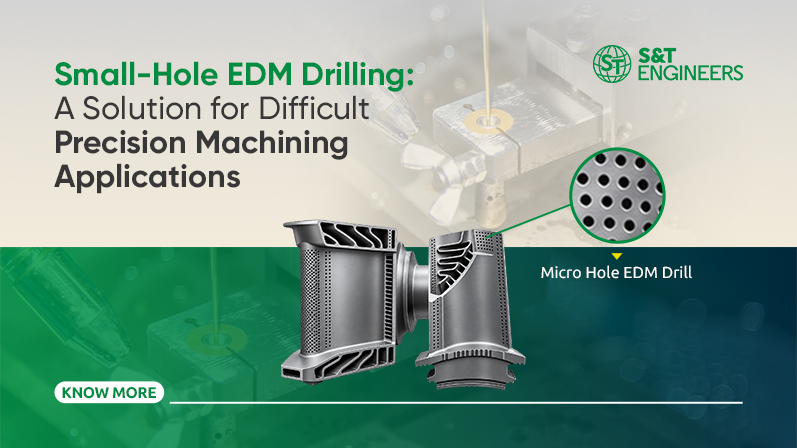
Making small / tiny / micro holes in highly hardened alloy metal materials is a significant challenge in cnc precision machining and manufacturing. Tool wear, cutting forces, difficult-to-machine alloys, and hole geometry can limit conventional drilling, particularly when components require specific hole diameters, depths, and positions. Small hole edm drilling machines solve this challenge by making fine holes on hardened steel and other alloys.
For manufacturers working with hardened tooling, turbine components, or precision fluid-control parts, selecting the right cnc machining process is essential. An EDM drilling machine offers an alternative for producing small holes in electrically conductive metals through controlled electrical discharges.
For S&T Engineers, small-hole EDM drilling is part of the broader equipment solutions available to manufacturers seeking suitable approaches to challenging fine hole-making applications.
How Does Small Hole EDM Drilling Solve Machining Challenges?
Small-hole Electrical Discharge Machining (EDM) removes material through repeated electrical discharges between an electrode and an electrically conductive workpiece. The discharges generate localized heat through electrical sparks, melting and vaporizing small amounts of material.
A dielectric fluid most probably the deionized water supports the discharge process and helps remove eroded particles from the machining zone. In machines equipped with tubular electrodes, fluid can also pass through the electrode to assist flushing.
Because the process does not depend on mechanical cutting action, EDM drilling can be suitable for hardened steels and selected high-performance alloys that are difficult in making deep hole drilling process conventionally.
However, EDM (Electrical Discharge Machining) is not automatically the best solution for every small hole. Its suitability depends on the workpiece material, required hole geometry, drilling depth, production requirements, and specified quality criteria.
Where Can EDM Hole Drilling Machines Make a Difference?
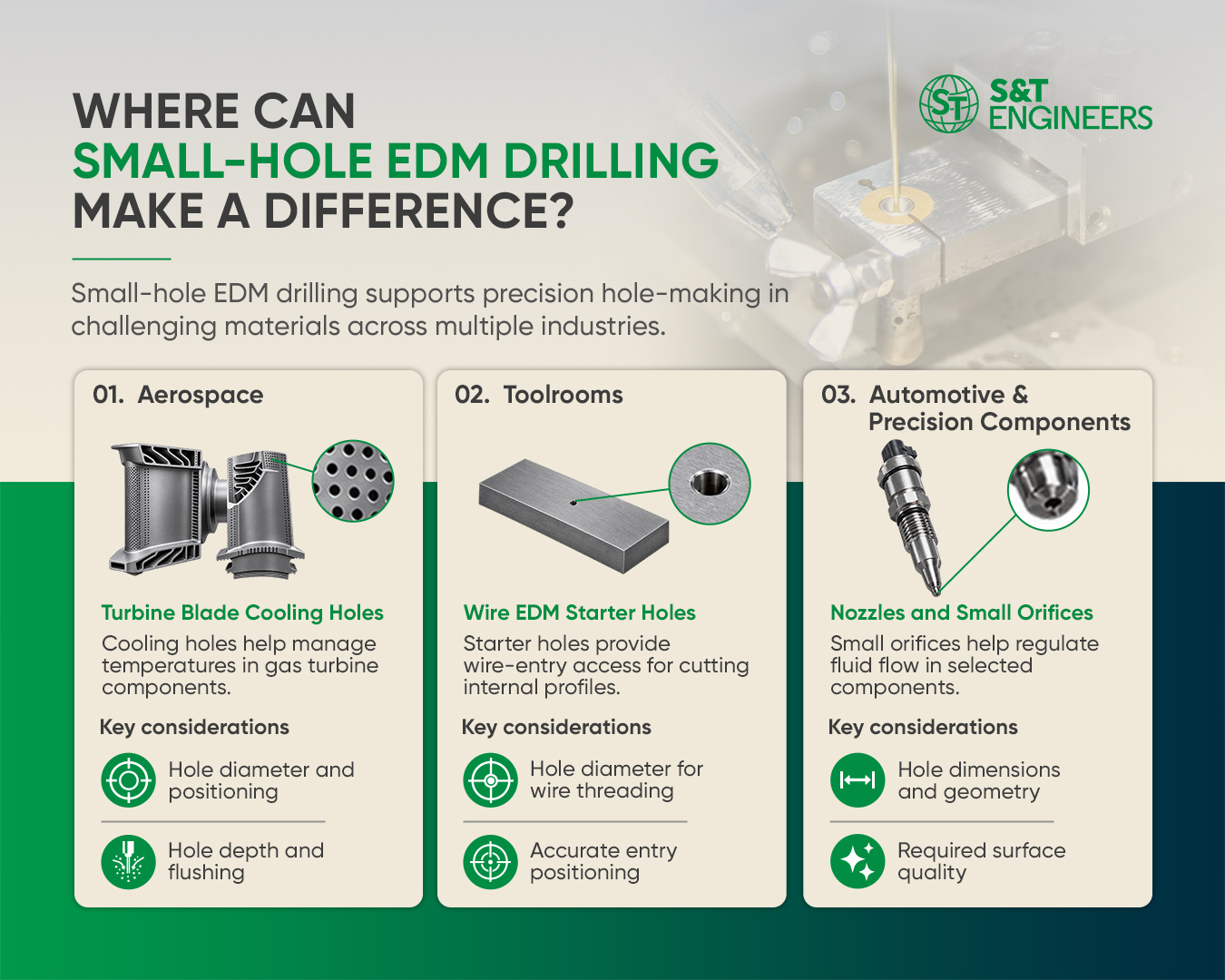
1. Aerospace Components: Cooling channels and Holes in Turbine Blades and Vanes
Turbine blades and nozzle guide vanes operate under demanding thermal conditions. Cooling holes, cooling passages and venting holes help direct air through or across component surfaces to manage temperatures during operation.
Producing these holes in heat-resistant alloys can be challenging with conventional cutting tools. EDM drilling may be suitable for specified cooling-hole applications where the process meets the component’s engineering requirements.
What manufacturers need to consider: Hole diameter, depth, position, and orientation must match the component drawing. Deeper holes can also create additional flushing challenges. The high-pressure flushing is required for removing eroded materials during the hole drilling process validation and inspection important.
2. Toolrooms: Starter Holes for Wire EDM
Wire EDM is commonly used to cut intricate profiles in electrically conductive hardened materials, including hardened tool steels. Before cutting an internal profile, a starter hole may be needed to thread the wire through the workpiece.
A small-hole EDM drill can produce this entry hole, preparing the precision components for subsequent Wire EDM cutting.
What manufacturers need to consider: The starter-hole diameter must suit the wire-threading arrangement. Tool Steel / Workpiece thickness, entry position, and the intended cutting path also influence the drilling requirement.
For toolrooms producing dies, punches, and precision tooling, evaluating these edm drilling process requirements helps determine the appropriate drilling approach.
3. Precision Fluid Components: Small Orifices and Nozzles (Tiny / small diameter holes)
Selected fuel-delivery components, nozzles, and fluid-control parts incorporate small orifices that regulate fluid flow. Their dimensional accuracy and geometry can influence functional performance.
Small-hole EDM drilling machines may be suitable when conventional machining struggles with the workpiece material
or specified feature. The process must still meet the required dimensional and surface-quality criteria.
What manufacturers need to consider: Hole diameter, depth, material, dimensional consistency, and inspection requirements. Depending on the component, functional flow testing may also be necessary.
What Should You Evaluate Before Selecting an EDM Drilling Machine?
- Electrode diameter range: Confirm that the machine accommodates the electrode sizes, hole diameter range required for the application.
- Drilling depth: Evaluate the required depth and whether the flushing efficiciency is met for removing debris.
- Workpiece dimensions and weight: Ensure that the component fits within the machine’s working capacity and electrode gemetry
- Positioning requirements: Consider the required hole location and the machine configuration needed to achieve it.
- Material and hole geometry: Check whether the intended workpiece and hole diameter hole straightness are suitable for the proposed EDM process.
- Production and inspection needs: Consider batch size, repeatability requirements, and how finished holes will be verified.
For demanding applications, representative workpiece trials can help establish whether the proposed process meets the component drawing and acceptance criteria.
Explore Small-Hole EDM Drilling Solutions from S&T Engineers
Selecting an EDM drilling machine involves more than comparing equipment specifications. Manufacturers need a solution that aligns with their workpiece material, hole requirements, production needs, and quality expectations.
S&T Engineers offers small-hole EDM drill machines under the SKITEK and OCEAN brands, giving manufacturers options to explore for their precision hole-making requirements.
Whether the application involves Wire EDM starter holes, selected tooling features, or other suitable small-hole machining tasks, the starting point is understanding the component and its technical requirements. The appropriate machine can then be evaluated against verified specifications and application needs.
Looking for a suitable EDM drilling machine? Contact S&T Engineers to discuss your machining requirements and explore small-hole EDM drilling solutions from SKITEK and OCEAN.