
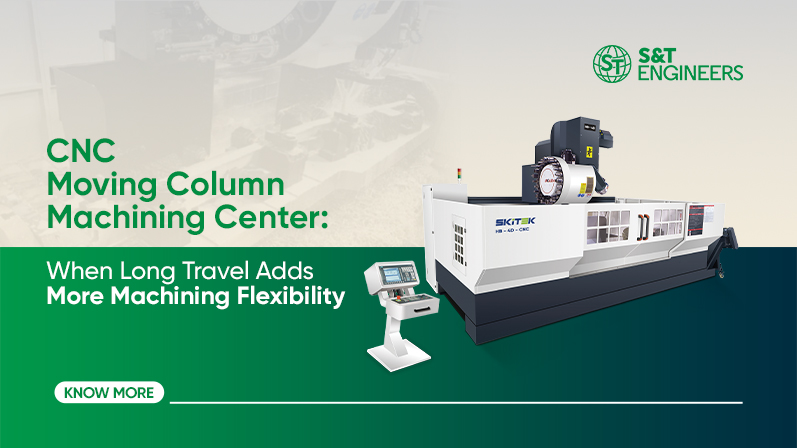
A CNC Moving Column Machining Center is designed for jobs where extended travel, stationary workholding and a longer machining range become important. It is especially useful when manufacturers handle long or heavy components, but its value also comes from the flexibility of the moving-column design.
Why Do Manufacturers Choose a Long Travel Machining Center?
A Long Travel Machining Center becomes relevant when the required machining length or workpiece handling starts to limit a standard setup.
Manufacturers may consider it when they need:
- Extended reach across longer components
- Reduced repositioning of long or heavy workpieces
- A stationary table for larger components or fixtures
- Multiple components arranged within the working area
- Better continuity across different machining locations
The key advantage is not only more travel, but the ability to use that travel while keeping the machining process organized around the workpiece.
How Does a Moving Column Machining Center Work?
In a moving-column design, the workpiece remains fixed on the table while the column and spindle travel along the longitudinal axis.
This allows the tool to reach different sections of the job without moving the loaded workpiece through the complete machining range. For long or heavy components, keeping the job stationary can simplify workholding and reduce repeated repositioning.
How Is It Different from a Long-Bed VMC?
Both machine types can provide extended machining capacity, but the working approach is different.
|
Long-Bed VMC |
Moving Column Machining Center |
|
Table and workpiece travel longitudinally |
Column and spindle travel along a fixed table |
|
Suitable when workpiece movement is manageable |
Useful when keeping the workpiece stationary is preferable |
|
Long table provides extended machining range |
Fixed long table provides extended machining range |
|
Setup is planned around table movement |
Setup is planned around travelling-column movement |
A moving-column design is not automatically better for every job. It becomes more relevant when component size, weight, setup arrangement or extended reach begins to influence the process.
What Components and Industries Use Long Travel Machining?
Long Travel Machining Centers can be used for common engineering materials such as steel, cast iron and aluminium, depending on tooling and machining conditions.
Typical applications include long machine frames, structural parts, plates, beams, machine beds, large fixtures, mould bases and other extended engineering components.
These requirements are found across general engineering, machine building, automotive, aerospace, railway and transportation, die & mould, and heavy engineering.
SKITEK Long Travel Machining Centers from S&T Engineers
S&T Engineers offers SKITEK CNC Moving Column / Long Travel Machining Centers for extended machining and specialized production requirements.
Explore the SKITEK range to identify the right machine for your component size, travel and production needs.
Need a specialised solution? Contact S&T Engineers for your machining needs.