
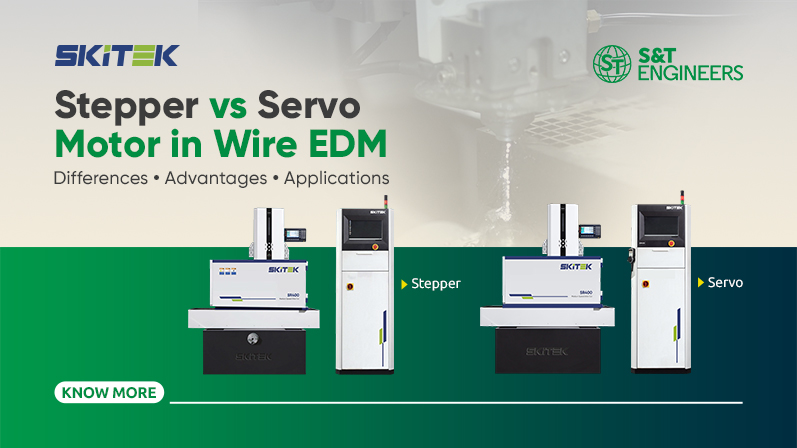
When selecting a Wire EDM machine, the motion system plays an important role in positioning the wire, following programmed profiles, and controlling axis movement. Stepper and servo motors are two motion technologies used in CNC-controlled machines, each offering different advantages.
Understanding their differences helps manufacturers choose a Wire EDM machine based on machining requirements, operational convenience, and budget.
What Is a Stepper Motor in Wire EDM?
A stepper motor moves in defined increments according to commands from the CNC control and drive system. In a typical open-loop configuration, the system does not continuously measure the motor's actual position through feedback.
Advantages of Stepper-Based Wire EDM Systems
1. Lower Initial Investment
Stepper-based systems can offer a lower initial investment, making them suitable for manufacturers seeking a cost-conscious Wire EDM solution.
2. Straightforward Motion Control
Their relatively simple control architecture makes them a practical option for applications that do not require advanced feedback-based motion control.
3. Manual Measuring Cycles
In S&T Engineers' stepper-based configuration, measuring cycles require manual intervention. This increases operator involvement during the machining process.
4. Manual Pitch-Coordinate Movement
Moving pitch coordinates requires manual intervention in the specified stepper-based configuration. These additional steps can increase operator workload and the possibility of manual errors.
5. Jog Speed
The specified stepper-based Wire EDM configuration offers a jog speed of 50 mm/min for axis positioning and movement during setup.
6. Suitable Applications
Depending on machine capability, stepper-based Wire EDM systems can be suitable for general profile cutting, fixtures, tooling, and die-and-punch applications.
What Is a Servo Motor in Wire EDM?
A servo motor uses feedback, typically from an encoder, to monitor actual position. The control system compares the commanded position with the feedback and responds to deviations within the system's capabilities.
Advantages of Servo-Based Wire EDM Systems
1. Feedback-Based Position Control
The feedback mechanism helps the control system monitor actual movement and respond to differences between commanded and actual positions.
2. Automated Measuring Cycles
In S&T Engineers' servo-based configuration, measuring cycles are automated. This reduces the need for manual intervention during the measuring process.
3. Automated Pitch-Coordinate Movement
Pitch-coordinate movements are automated in the specified servo-based configuration. This simplifies operation and helps minimize operator-related errors.
4. Higher Jog Speed
The specified servo-based Wire EDM configuration offers a jog speed of 1,000 mm/min, this can reduce axis positioning time during setup.
5. Advanced Motion Control
Servo systems can support responsive motion control and coordinated multi-axis movement, depending on the machine design.
6. Suitable Applications
Depending on machine configuration, servo-based Wire EDM systems can be advantageous for complex profiles, taper cutting, precision tooling, and applications requiring coordinated multi-axis movement.
Stepper vs Servo Motor: Key Differences
|
Parameter |
Stepper-Based System |
Servo-Based System |
|
Initial investment |
Generally lower |
Generally higher |
|
Position feedback |
Typically, open loop |
Typically closed loop |
|
Measuring cycles |
Manual intervention |
Automated |
|
Pitch-coordinate movement |
Manual intervention |
Automated |
|
Jog speed |
50 mm/min |
1,000 mm/min |
|
General profile cutting |
Suitable for appropriate applications |
Suitable |
|
Complex profiles and taper cutting |
Depends on configuration |
Can be advantageous |
|
Multi-axis movement |
Application dependent |
Suitable for coordinated motion |
|
Machining accuracy |
Depends on complete machine design |
Depends on complete machine design |
Does a Servo Motor Always Guarantee Better Wire EDM Accuracy?
No. Motor type alone does not determine machining accuracy. Overall performance depends on the CNC control, feedback system, drive performance, ball screws, linear guides, machine rigidity, thermal stability, wire tension and guiding, EDM power supply, and calibration.
Manufacturers should therefore evaluate the complete machine configuration against their machining requirements rather than if one motor type automatically guarantees better accuracy.
Choose the Right Wire EDM System for Your Application
At S&T Engineers, we offer Wire EDM solutions with both stepper-based and servo-based motion systems. The right choice depends on your component geometry, positioning requirements, production volume, required automation, and budget.
Choose the motion system based on your machining requirements - not simply the motor name.
Contact S&T Engineers to discuss your Wire EDM application and identify a suitable machine configuration.