
In precision manufacturing, mirror finish is an important surface-quality requirement for molds, dies, tools, and precision components. A smooth, highly reflective surface can improve component appearance while reducing polishing and secondary finishing.
Electrical Discharge Machining (EDM) can achieve fine surface finishes through controlled electrical discharges. With the right machining parameters and finishing process, EDM can produce smooth and consistent surfaces for demanding applications.
What Is a Mirror Finish?
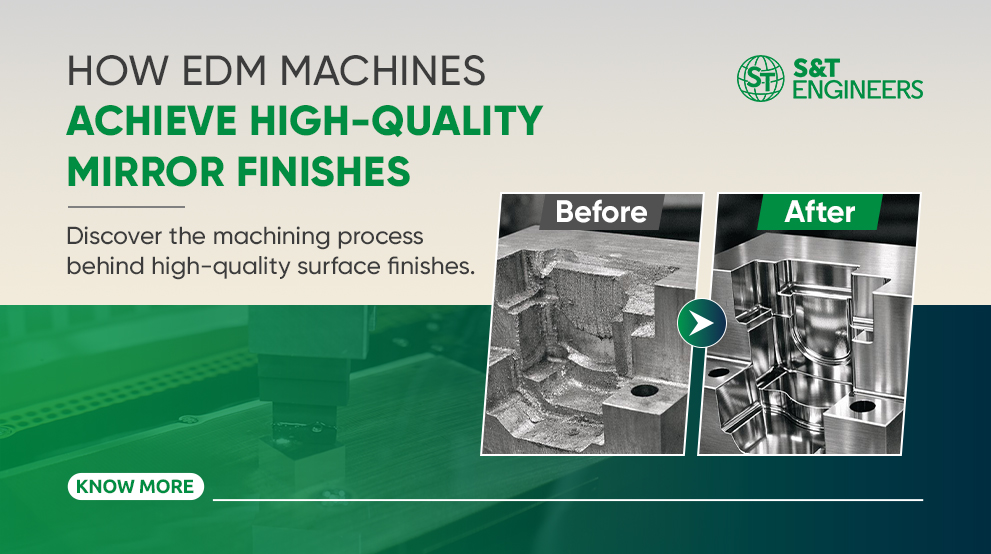
A mirror finish is a very smooth and reflective surface with low surface roughness. Compared with a standard machined surface, it has fewer visible irregularities and a more uniform appearance.
Surface roughness is commonly measured using Ra (arithmetical average roughness). A lower Ra value generally indicates a smoother surface. The required Ra depends on the material, application, geometry, and required surface quality.
A good mirror finish can also reduce the manual polishing required after machining.
Why Is Mirror Finish Important?
Mirror finish is important when surface appearance, mold quality, and consistency matter.
Key benefits include:
- Reduced polishing and secondary finishing
- Better surface appearance
- Consistent surface quality
- Reduced finishing time
- Lower manual finishing effort
- Improved production efficiency
For complex mold cavities and dies, reducing manual polishing can help save time and maintain consistent results.
Where Is Mirror Finish Used?
Mirror finish requirements are common in several manufacturing applications.
Die & Mold Industry:
Mold cavities, core inserts, die-casting dies, and precision inserts require mirror finishes for smooth molded surfaces.
Automotive Industry:
Lighting molds, dashboard molds, exterior-part molds, and die-casting dies need fine finishes for better surface appearance.
Aerospace Industry:
Turbine blade tooling, forming dies, mold cavities, and precision tools require fine finishes for demanding applications.
Medical Manufacturing:
Medical molds, surgical tools, implant tooling, and precision cavities need smooth surfaces for quality and consistency.
Tool & Die Manufacturing:
Punches, stamping dies, forming tools, and extrusion dies require mirror finishes to reduce friction and polishing.
Electronics & Precision Components:
Connector molds, electronic housings, micro-component molds, and precision inserts require fine finishes for accurate replication.
Plastic Injection Molding:
Optical molds, lens molds, core inserts, and mold cavities require mirror finishes for smooth, glossy components.
How Do EDM Machines Achieve Mirror Finish?
EDM machines achieve fine surface finishes by controlling the electrical discharge between the electrode and workpiece. Each discharge removes a small amount of material, creating microscopic craters on the surface.
By controlling discharge energy, pulse duration, machining parameters, and finishing passes, these surface irregularities can be reduced.
When a mirror-like surface finish is required, CNC Die-Sinking EDM is particularly suitable for mold cavities, dies, inserts, and complex-shaped components.
Unlike Wire EDM, which uses a continuously moving wire to cut through the workpiece, Die-Sinking EDM uses a shaped electrode to create the required cavity or profile. This makes it suitable for detailed cavity machining and complex shapes.
How Does Die-Sinking EDM Produce a Mirror Finish?
The process is completed through controlled machining stages:
1. Rough Machining:
Higher discharge energy removes material efficiently and creates the required cavity shape.
2. Semi-Finishing:
Machining parameters are adjusted to remove remaining material while improving accuracy and surface quality.
3. Fine Finishing:
Lower discharge energy and shorter pulse conditions create smaller, controlled discharges, reducing surface crater size.
4. Mirror Finishing:
Additional finishing passes with carefully controlled electrical parameters progressively improve the surface. Proper flushing, electrode condition, and finishing strategy also contribute to the final result.
The final surface quality depends on the work piece material, electrode material, electrical parameters, flushing conditions, machine stability, and finishing passes.
Choose the Right Die-Sinking EDM with S&T Engineers
A mirror finish depends on more than the machine alone. The right EDM technology, machining parameters, finishing strategy, and technical support are important for achieving the required result.
At S&T Engineers, we provide CNC Die-Sinking EDM solutions for mold, die, aerospace, medical, tool, and precision-component applications. We help manufacturers select the right machine based on their component geometry, material, production requirements, and surface-finish needs.
Looking for a Die-Sinking EDM solution for your mirror-finish application? Talk to S&T Engineers to find the right machine for your requirement.