
Workholding plays a significant role in how a milling operation is set up. While the milling machine provides the machining capability, the workholding arrangement determines how the component is secured, positioned, and presented to the cutting tool.
From general-purpose machining to components requiring angular positioning or controlled rotation, different applications can call for different workholding approaches. Selecting the right solution therefore depends on more than simply holding the workpiece in place.
What Makes a Workholding Setup Suitable?
A suitable workholding arrangement needs to provide secure clamping while allowing the required machining areas to remain accessible. Component geometry, size, machining direction, and the number of faces being machined can all influence the setup.
For some jobs, a standard fixed holding arrangement may be sufficient. Other applications may benefit from additional positioning or rotational capability. This is why milling setups can use different combinations of vises and positioning equipment depending on the component and operation.
When Standard Workholding Is the Right Choice
For many milling applications, the primary requirement is to hold the workpiece securely and maintain a stable setup during machining.
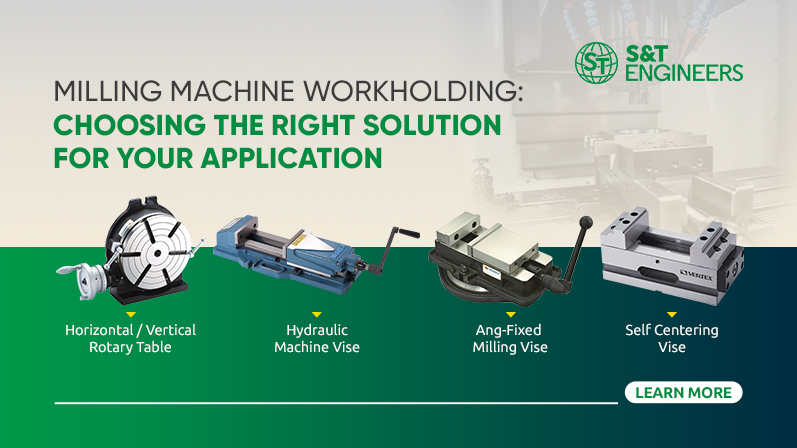
A Hydraulic Machine Vise can be suited to applications where hydraulic clamping is preferred, particularly for setups requiring consistent clamping across repeated machining operations.
An Angle Fixed Milling Vise, on the other hand, provides a fixed inclined holding arrangement when the workpiece needs to be positioned at a specific angle during machining.
When Self-Centering Can Simplify the Setup
Workpiece geometry can also influence how the component is positioned within the vise.
A Self-Centering Vise provides a workholding arrangement that centres the component as it is clamped. This can be useful when maintaining the workpiece's position relative to the machine setup is an important part of the machining process.
The value of this type of workholding is not simply the clamping itself, but how the arrangement supports repeatable positioning during setup.
When the Workpiece Needs to Rotate
Some milling applications involve features distributed around a component, angular machining, indexing, or machining at different orientations. In these cases, fixed workholding alone may not provide the required flexibility.
A Vertical / Horizontal Rotary Table allows the workpiece to be positioned and rotated according to the machining requirement. Its ability to operate in different orientations makes it suitable for applications where the component needs controlled angular positioning or access to features around its geometry.
Selecting Workholding Around the Application
There is no single workholding arrangement that suits every milling application. The appropriate choice depends on how the component needs to be held, positioned, oriented, and machined.
A well-planned workholding setup can make the machining process more adaptable to different component geometries and production requirements. By considering the application, manufacturers can select a suitable arrangement that supports both the machining process and the way the machine is used.
Explore S&T Engineers' Milling Machine Workholding Solutions for your application.