
Machining large dies and moulds with multiple cavities, deep features, or off-centre locations can make electrode positioning more challenging. When machining features are spread across a larger workpiece, the EDM machine needs sufficient travel, working space, and positioning flexibility to reach each location accurately.
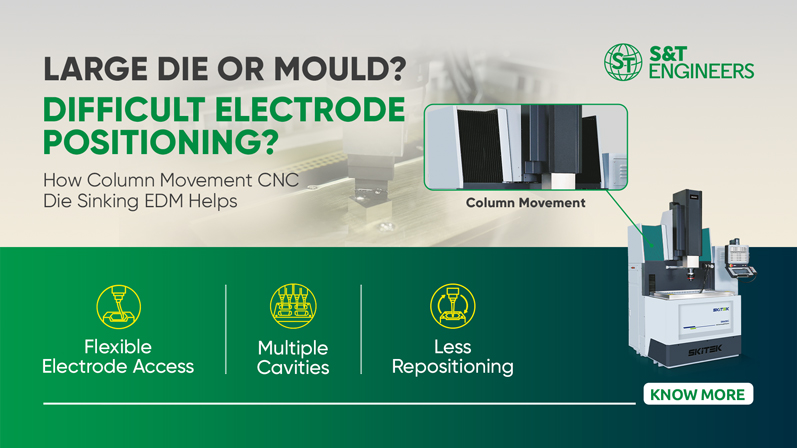
This is where a column-movement CNC Die Sinking EDM Machine can provide a practical advantage. By incorporating column movement into the machine configuration, the electrode can access different machining locations within the available working envelope, potentially reducing unnecessary workpiece repositioning.
Why Is Electrode Positioning Difficult on Large Dies and Moulds?
Large dies and moulds often contain multiple cavities, deep pockets, corners, inserts, and off-centre features. When these features are distributed across a larger workpiece, positioning the electrode becomes an important part of the machining setup.
Three situations can create particular challenges:
Multiple cavities: Die and mould components may have several cavities positioned at different locations, requiring the electrode to move accurately between machining areas.
Off-centre features: Features located away from the centre require sufficient machine travel and clearance to bring the electrode into the correct machining position.
Large workpieces: The overall size and weight of the die or mould, cavity locations, electrode dimensions, and required machining depth all need to be considered when selecting an EDM machine.
How Does Column Movement Help?
A column-movement CNC Die Sinking EDM Machine uses movement of the machine column as part of its positioning configuration. This can provide greater flexibility when accessing machining features distributed across a die or mould.
For multiple-cavity applications, suitable column movement and machine travel can help the electrode reach different machining locations without relying solely on workpiece repositioning.
For off-centre cavities and features, the available X, Y, and Z travel becomes especially important. If the required locations fall within the machine’s practical working envelope, column movement can simplify electrode positioning and setup.
This does not mean workpiece repositioning is eliminated in every application. Actual suitability depends on the die or mould dimensions, feature locations, electrode arrangement, machining depth, and required accuracy.
What Should You Check Before Choosing a CNC Sinker EDM?
Before selecting a CNC Sinker EDM Machine, also known as a Die Sinking EDM or RAM EDM, consider the complete machining requirement:
- Workpiece dimensions and weight
- X, Y, and Z-axis travel
- Worktable and work tank dimensions
- Cavity locations and machining depth
- Electrode dimensions and number of electrodes
- Required machining accuracy and surface finish
- Automation and rotation requirements
- Die, mould, or mould-insert application
Looking at these factors together gives a more realistic understanding of whether a particular EDM configuration is suitable for the job.
SKITEK SN 400C: Column-Movement CNC Die Sinking EDM Machine
At S&T Engineers, the SKITEK SN 400C is offered as a column-movement CNC Die Sinking EDM Machine for die and mould applications requiring flexible electrode positioning and high-quality surface finishing.
The machine features a Linux controller and is available with application-focused options including:
- Mirror-finish capability
- Rise-and-fall tank option
- Erowa-type C-axis
- 12-tool ATC (Automatic Tool Changer)
- Oil chiller
These features can be valuable for complex die and mould machining. The 12-tool ATC can support machining processes requiring multiple electrodes by reducing the need for frequent manual tool changes.
The Erowa-type C-axis provides rotational capability for applications where electrode or workpiece rotation is required. The rise-and-fall tank option can provide additional flexibility during workpiece setup and machining access, depending on the application.
The oil chiller supports temperature control during machining, which can be important when process stability and finishing requirements need to be maintained.
Is Column Movement Right for Your Die or Mould?
Column movement may be worth considering when your application involves multiple cavities, off-centre features, distributed machining locations, or multiple electrodes.
However, machine selection should be based on the actual machining requirement rather than the overall size of the die or mould alone. The feature locations, electrode requirements, working envelope, machining depth, and finishing requirements all need to be evaluated.
Need CNC Die Sinking EDM for Your Die or Mould?
If you are machining a large die, mould, mould insert, or complex cavity and are facing electrode-positioning challenges, share your drawing and machining requirements with S&T Engineers.
We can evaluate the workpiece dimensions, cavity locations, electrode requirements, and machining needs to help determine whether the SKITEK SN 400C is suitable for your application.