
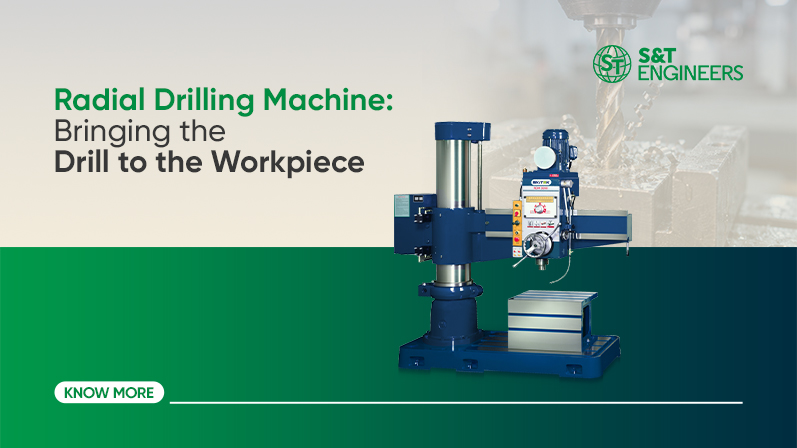
A Radial Drilling Machine is designed for larger or heavier workpieces where drilling is required at multiple positions across the component. Its radial arm and movable drilling head provide the reach needed to access different positions while the component remains securely set, making it practical for multi-hole drilling in engineering and fabrication work.
Why Is a Radial Drilling Machine Useful for Larger Workpieces?
As components become larger, the drilling requirement depends on more than hole diameter alone. Workpiece size, hole location and the distance of the hole from the component edge all influence how easily the job can be machined.
A radial drilling machine provides a wider working envelope for plates, fabricated structures and machine parts requiring holes at different positions.
How Does the Radial Drilling Mechanism Work?
The drilling head is mounted on a radial arm and travels along the arm to reach different points within the machine’s working range. The arm helps align the spindle with the required hole location.
This allows the setup to follow the component dimensions and hole pattern.
What Operations Can Be Performed?
Depending on tooling and machine configuration, a radial drilling machine can support:
- Drilling
- Reaming
- Countersinking
- Related hole-preparation work
Select the required capability according to material, hole diameter and regular workload.
How Do You Choose the Right Radial Drilling Machine?
Machine selection should connect the specification directly to the workpiece. Two of the most important factors are drilling capacity and reach.
|
Workpiece requirement |
Specification to check |
Why it matters |
|
Largest hole and material |
Drilling capacity in steel / cast iron |
Confirms whether the required hole size is within machine capacity |
|
Hole located farther across the component |
Maximum spindle-centre-to- column distance |
Shows how far the spindle can reach across the job |
|
Large component or fixture |
Available working clearance |
Confirms that the workpiece and fixture can be accommodated |
|
Regular production work |
Spindle speeds and feeds |
Helps match the machine to the normal workload |
A larger hole in steel may require greater drilling capacity, while a hole positioned well inside a wide plate may make spindle reach the more important specification. The right machine is therefore determined by the actual component, not by one specification alone.
Where Are Radial Drilling Machines Commonly Used?
Radial drilling machines are suited to general engineering, fabrication, maintenance and machine-building environments. Typical work includes plates, fabricated frames and machine components requiring holes at multiple locations.
SKITEK Radial Drilling Machines from S&T Engineers
S&T Engineers offers SKITEK Radial Drilling Machines for a wide range of engineering, fabrication and maintenance requirements.
The range is designed to support different workpiece sizes, drilling needs and shop-floor conditions, giving manufacturers flexibility to select a machine based on their regular application and workload.
Choose the SKITEK Radial Drilling Machine that best matches your component size, drilling requirement and production needs.