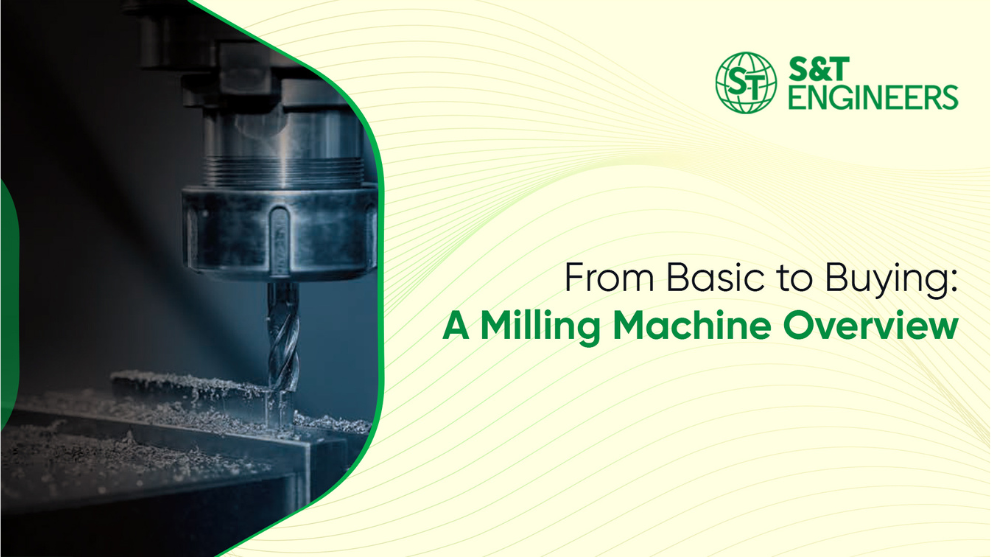
From Basic to Buying: A Milling Machine Overview
In a small-town workshop decades ago, a machinist trusted his hands, his hearing, and the hum of a manual milling machine to turn raw steel into precision tools. There were no screens or codes — just craftsmanship and control. Fast forward to today, and you’ll still find conventional milling machines humming in many workshops, performing various milling and drilling operations, proving that some tools never go out of style.
What Is a Milling Machine?
A milling machine removes material using rotary cutters and has shaped industries since the 19th century. While CNC is widespread today, conventional milling machines remain vital for their control, affordability, and reliability in workshops and tool rooms.
Operations Performed by Milling Machine
Face Milling – Flat Surface Finishing
Creates a smooth, flat surface on the workpiece and is often the first step for accurate machining setup.
Slotting – Creating Channels and Keyways
Cuts narrow grooves or keyways to ensure proper fits for shafts and mechanical components.
Drilling – Making Holes with Accuracy
Performs vertical hole-making with greater control, ideal for multi-hole or angled layouts.
Boring – Enlarging Pre-Drilled Holes
Refines and enlarges existing holes with tight tolerances, perfect for bushings and precise fits.
Thread Milling – Cutting Internal or External Threads
Forms internal or external threads with high accuracy and cleaner finishes than traditional tapping.
Contouring – Shaping Curves and Profiles
Shapes curved or angled surfaces effectively, making it ideal for moulds and complex components.
How to Choose the Right Conventional Milling Machine?
Table Size & Travel:
- Select a table size at least 20% larger than your typical workpieces.
- Ensure sufficient X, Y, and Z travel to accommodate setup flexibility, tool clearance, and fixture heights.
Spindle Speed & Power:
- Choose a milling machine with a wide spindle speed range to handle various materials and operations.
- Higher motor power ensures smoother, more consistent performance, especially when working with tougher materials like stainless steel or alloys.
Rigidity & Build
- Opt for heavy-duty cast iron construction to maintain accuracy and minimize vibration during heavy cuts.
- Ensure a well-designed column and base structure that provides stability even at maximum loads.
Control Features & Ease of Use
- Digital Read-Out (DRO) systems enhance accuracy and reduce manual measurement errors.
- Choose smooth-operating handwheels and clearly marked ergonomic controls for comfortable, efficient machining.
Service and Spare Part Availability
- Confirm pan-India availability of technical support and spare parts to minimize downtime.
Why Choose S&T Engineers Milling Machines?
At S&T Engineers, we offer Vertical Turret Milling Machines built with robust castings, precision spindles, and operator-friendly features. Equipped with digital readouts (DRO) and designed for low maintenance, our machines are ideal for workshops seeking reliable, long-term performance.
Explore our complete range of conventional milling machines — the perfect choice for industries.
- Visit Our Milling Machine Page
- Reach out to our team to know more.



Trading Unit of S&T Group
Contact Address
S&T Engineers (P) Ltd
22, Vasanth Nagar, Singanallur, Coimbatore - 641005, Tamil Nadu, INDIA.
For Machine Enquiry:
+91 73976 85550
Quick Links
Other Links
Subscribe to Newsletter
Stay In Touch
Copyrights © 2026 S&T ENGINEERS
Other Links
Stay In Touch
Copyrights © 2026 S&T ENGINEERS
