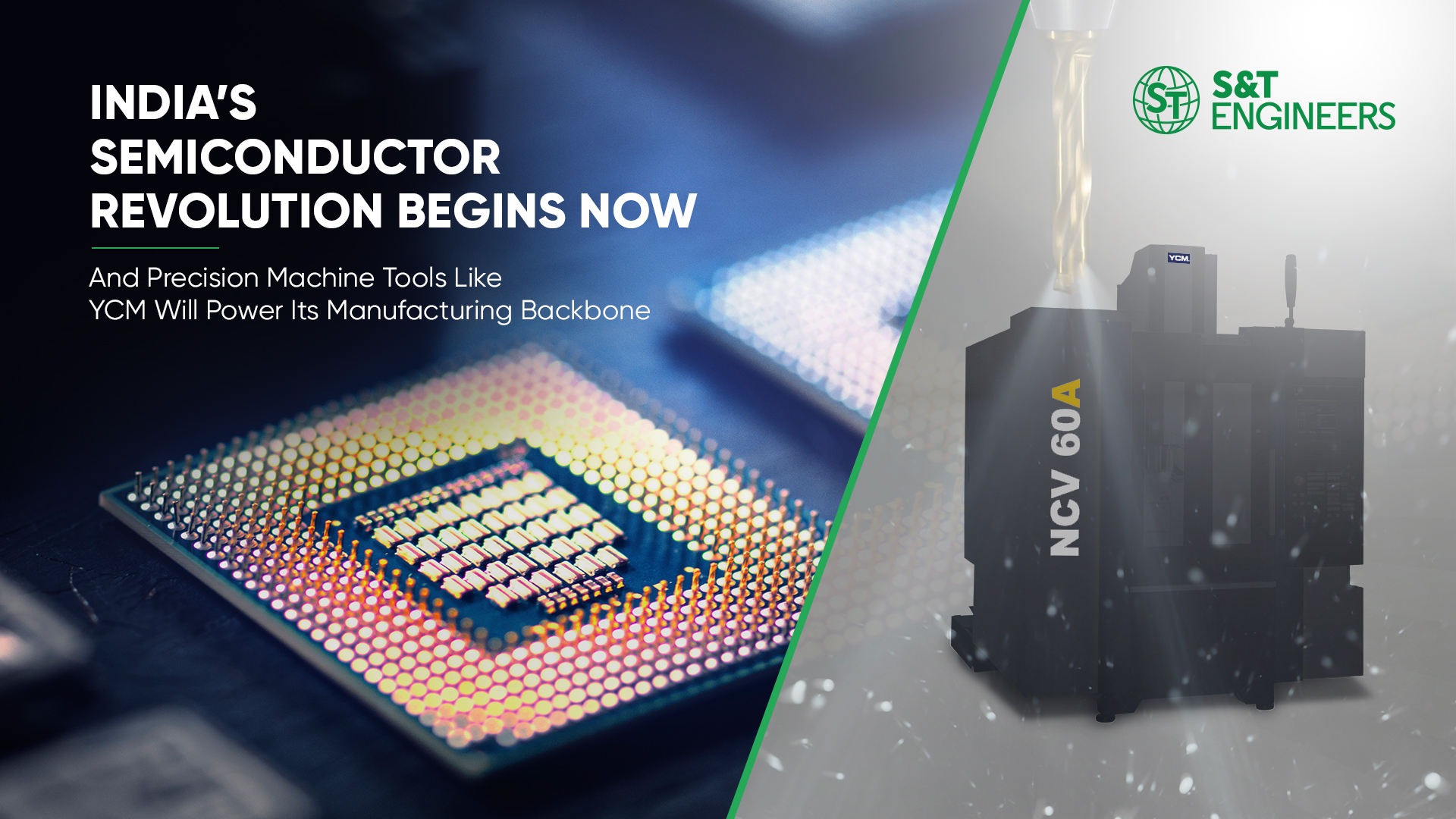
Why India’s Semiconductor Revolution Will Redefine Precision Manufacturing in 2025–2030
Over the last decade, India has accelerated its push toward becoming a global manufacturing powerhouse. But in 2025, a very different kind of industrial wave is taking shape, the semiconductor revolution.
Most people see semiconductors as high-tech chips, clean rooms, white suits, and billion-dollar fabs. But behind every chip that gets produced, there is something far more fundamental:
👉 Precision manufacturing.
👉 High-accuracy machining.
👉 Thousands of engineered mechanical components.
And this is where the real story begins for India’s manufacturing ecosystem.
🌏 The World Is Rebuilding Its Semiconductor Supply Chain
The chip shortage of 2020–2022 exposed a global vulnerability:
Semiconductor supply chains were too concentrated, too fragile, and too slow to diversify.
Today:
• The US, Europe, Japan, and India are all reshoring chip manufacturing
• Global fabs are looking for new supplier ecosystems
• Countries with strong machining + tooling capability are becoming strategic partners
And India — with its large engineering base — is ready to enter this space.
But there is a catch.
🔧 Fabs Don’t Run on Electronics Alone — They Run on Mechanical Precision
Every fab requires tens of thousands of precision mechanical parts, such as:
• Equipment frames
• Vacuum chambers & flanges
• Motion-stage brackets
• Heat spreader housings
• Alignment plates
• Aluminum baseplates
• Stainless steel utility components
• ATMP molds and dies
• Test fixtures, carriers, nests, pallets
The surprising truth:
👉 Over 70% of these components are currently imported into India.
👉 Domestic precision shops are not yet fully aligned to semiconductor-grade tolerances.
This gap is not a problem — it is a once-in-a-generation opportunity.
📈 India’s Semiconductor Mission = A New Manufacturing Boom
With announced fabs and ATMP units in Gujarat, UP, Odisha, and Assam, the semiconductor ecosystem is about to create:
• New Tier-2 & Tier-3 supplier networks
• High-value machining clusters
• Specialized tooling industries
• New opportunities for MSMEs with precision capability
• A demand curve for advanced CNC machining never seen before in India
The fabs may be worth ₹20,000–30,000 crore…
But the support ecosystem business is worth several times more over the next decade.
This is where Indian machine shops come in.
🔍 The Precision That Semiconductors Really Need
Typical semiconductor mechanical components require:
• ±5–10 micron repeatability
• High surface finish (Ra < 0.8 µm for aluminum)
• Thermal stability during long runs
• Rigidity to avoid micro-vibration
• High spindle speeds for aluminum
• Accurate geometric tolerances for chamber parts
This is not aerospace, not automotive — it is another level of consistency.
Which means:
👉 Machine tools become the foundation of the semiconductor supply chain.
👉 Shops with the right VMCs, EDMs, grinders, and CMMs will dominate.
👉 India needs to rapidly scale its machining capability to match global semiconductor expectations.
🛠️ And This Is Where Our Solutions Come In
A semiconductor-ready machining ecosystem needs machines that offer:
• High rigidity for chamber & frame machining
• Ceramic bearing spindles for stable finishing
• Roller guideways for structural stiffness
• ±7 micron repeatability for precision parts
• Thermal control systems for long-cycle accuracy
• High-speed spindles for aluminum machining
Our VMC solutions are engineered around these exact requirements — making them ideal for:
• Vacuum chamber parts
• Fixtures and carriers
• Aluminum tool plates
• Motion stage brackets
• ATMP mold bases
• SS304/316 semiconductor housings
We are already aligning machine configurations to support semiconductor Tier-2/Tier-3 suppliers across upcoming clusters.
🚀 The Window of Opportunity (2025–2030)
India is positioning itself for a decade of semiconductor growth.
Between 2025 and 2030, the companies that will grow the fastest are:
• Precision machining shops adopting semiconductor-grade processes
• Tooling & mold companies upgrading to high-accuracy VMCs
• Machine tool providers who understand semicon requirements
• Tier-2 and Tier-3 suppliers who localize high-value components
The question is no longer:
“Will India enter semiconductors?”
The real question is:
“Which Indian manufacturers are ready to scale into semiconductor precision — with technology support from global leaders like YCM?”



Trading Unit of S&T Group
Contact Address
S&T Engineers (P) Ltd
22, Vasanth Nagar, Singanallur, Coimbatore - 641005, Tamil Nadu, INDIA.
For Machine Enquiry:
+91 73976 85550
Quick Links
Other Links
Subscribe to Newsletter
Stay In Touch
Copyrights © 2026 S&T ENGINEERS
Other Links
Stay In Touch
Copyrights © 2026 S&T ENGINEERS
