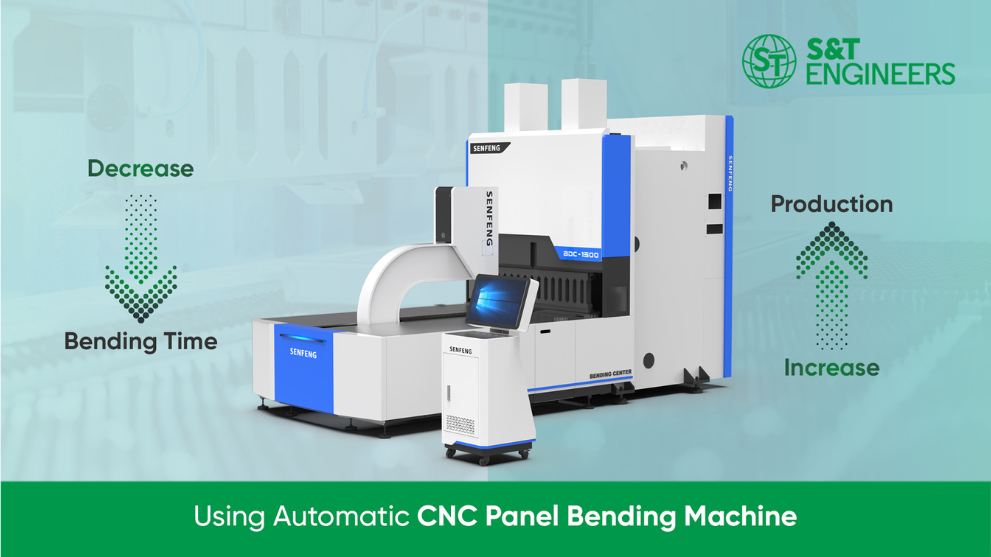
How an MSME Cut Bending Time by 40% Using a CNC Panel Bender
For most MSMEs (Micro, Small, and Medium Enterprises) in the sheet metal fabrication industry, staying competitive means producing quality parts faster and with fewer errors. In a market driven by tight delivery schedules and razor-thin margins, outdated bending methods can become a major bottleneck. This case study examines how one MSME transformed its sheet metal fabrication process by implementing an automatic CNC panel bending machine, resulting in a 40% reduction in bending time and an overall efficiency improvement.
The Challenge: Manual Bending Slowing Down Production
Based in Coimbatore, this mid-sized sheet metal fabrication company primarily served OEMs in the electrical enclosure and HVAC sectors. While their craftsmanship was strong, their production line relied heavily on manual press brakes.
Problems they faced included:
• High setup time for tool changes
• Skilled labor dependency for complex bends
• Inconsistent edge accuracy on repeat jobs
• Missed delivery timelines during peak orders
Management realized that to scale operations and meet customer demands, they needed to reduce setup delays and improve process repeatability.
Traditional vs Automatic Panel Bending Machine – Key Differences
Upgrading from traditional bending to an Automatic CNC Panel Bender can dramatically improve speed, accuracy, and ROI. Here’s a quick comparison:
Aspect | Traditional | Automatic |
Setup Time | Frequent manual tool changes; slow | Minimal tool changeovers; fast |
Skill Need | High operator dependency | Consistent accuracy, low dependency |
Speed | Slower, especially for complex bends | Up to 40% faster with optimized sequencing |
Accuracy | Higher risk of errors | High repeatability and precision |
Labor Cost | More manpower needed | Fewer operators handle more production |
ROI | Slower, depends on efficiency | Faster (often within a year); scalable |
The Solution: Installing an Automatic CNC Panel Bending Machine
After evaluating various solutions, the company decided to invest in a CNC panel bending machine with automatic tool adjustment and servo-driven bending arms. The system offered several key features:
• Automatic bend sequencing based on part geometry
• Zero tool changeovers between jobs
• Integrated software for programming and simulation
• High repeatability regardless of operator skill
Installation was completed in under three weeks, and basic operator training took just two days due to the machine’s intuitive interface.
The Results: 40% Faster Bending Time and Streamlined Production
The change was immediate and measurable.
✅Setup time dropped by 70% – no more time-consuming tool setups for each part.
✅ Reduce bending time by 40% per part – made possible by optimized bend sequencing and automation.
✅ Operator errors fell to near zero, significantly reducing scrap and rework.
✅ Production volume increased by 25% within the first two months.
✅ Faster turnaround time helped win two new OEM contracts.
ROI Within a Year
The company achieved a full return on its panel bending machine investment in just 11 months. By streamlining operations, reducing labor costs, increasing production capacity, and minimizing rejected parts, they not only covered the purchase cost quickly but also set the stage for sustained profitability.
What This Means for MSMEs
This case proves that automation empowers MSMEs to compete directly with large factories. By adopting scalable, user-friendly solutions like CNC automatic panel benders, MSMEs deliver better quality, achieve faster turnaround times, and lower operational costs while strengthening their position in the market.
Conclusion
For small to mid-sized manufacturers, automating panel bending isn’t just a technology upgrade, it’s a direct path to faster production, higher precision, and lower operating costs. By embracing CNC panel bending automation, MSMEs in sheet metal fabrication can meet customer demands more efficiently and secure a stronger competitive edge.
Ready to Transform Your Bending Operations?
If you’re still relying on traditional bending machines and facing setup delays, operator dependency, or missed delivery timelines, now is the perfect time to explore the benefits of an automatic CNC panel bender.
Contact S&T Engineers today to schedule a live demo or discuss a customized solution for upgrading to an automatic CNC panel bending machine.



Trading Unit of S&T Group
Contact Address
S&T Engineers (P) Ltd
22, Vasanth Nagar, Singanallur, Coimbatore - 641005, Tamil Nadu, INDIA.
For Machine Enquiry:
+91 73976 85550
Quick Links
Other Links
Subscribe to Newsletter
Stay In Touch
Copyrights © 2026 S&T ENGINEERS
Other Links
Stay In Touch
Copyrights © 2026 S&T ENGINEERS
