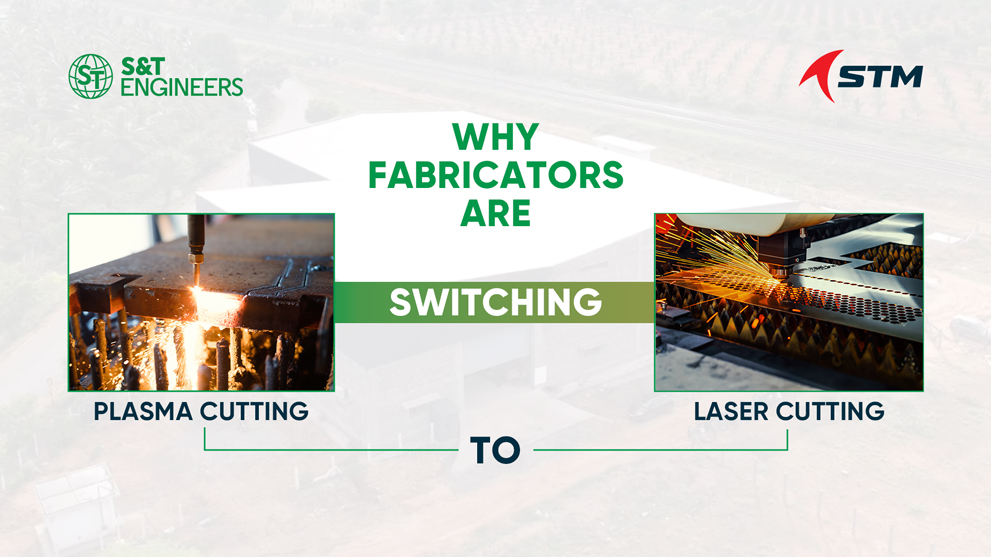
Plasma Cutter vs Laser Cutter: Why Fabricators are Switching from Plasma to Laser Cutting Machines
In the metal fabrication industry, cutting technology plays a critical role in productivity, accuracy, and profitability. For decades, the plasma cutter has been a reliable choice for fabricators, especially for working with thick metals. However, with growing demands for precision, automation, and versatility, many fabricators are now making the shift from plasma cutting to laser cutting.
Now, we’ll explore the plasma cutter vs laser cutter comparison, highlight the advantages and disadvantages of each, and explain why fabricators are switching to laser cutting.
What is Plasma Cutting?
Plasma cutting uses an electrically ionized gas (plasma) to cut through conductive metals such as steel, stainless steel, and aluminium. It has been widely adopted in heavy industries for its ability to slice through thick materials quickly.
Advantages of Plasma Cutting
• Cost-effective for thick plates and heavy-duty jobs
• Fast cutting speeds for structural applications
• Portable and durable machines suitable for workshops and field use
Limitations of Plasma Cutting
• Lower precision compared to laser cutting
• Produces rough edges, requiring secondary finishing
• Limited ability for intricate or detailed designs
• Higher heat-affected zones leading to material distortion
What is Laser Cutting?
Laser cutting uses a high-powered laser beam to cut or engrave materials with exceptional precision. Unlike general-purpose laser machines that work on plastics, composites, or wood, our STM laser cutting machines are designed specifically for stainless steel, mild steel, and aluminium, the core materials used in metal fabrication industries.
Advantages of Laser Cutting
• High precision & accuracy: Cuts with tight tolerances and fine detail
• Clean edges: Minimal finishing required
• Material versatility: Works on different metals
• Automation ready: Integrates with CNC, CAD/CAM, and Industry 4.0 workflows
• Efficiency: Reduces scrap, rework, and labour time
Limitations of Laser Cutting
• Higher initial investment compared to plasma
• Not always suitable for extremely thick plates
Plasma Cutting vs Laser Cutting: Key Differences
|
Feature |
Plasma Cutter |
Laser Cutter |
|
Cutting Speed |
Fast on thick materials |
Faster on thin to medium materials |
|
Precision |
Moderate |
Extremely high |
|
Material Range |
Conductive metals only |
Metals + non-metals |
|
Finish Quality |
Requires post-processing |
Smooth, clean edges |
|
Cost |
Lower upfront cost |
Higher upfront, better long-term ROI |
Why Fabricators are Moving from Plasma to Laser Cutting
The shift from plasma cutting to laser cutting is driven by market and production demands. Some key reasons include:
• Higher accuracy and quality finishes – essential for industries like aerospace, automotive, and electronics
• Better efficiency – less rework, fewer defects, and minimal post-processing
• Automation and digital integration – laser cutters work seamlessly with smart manufacturing systems
• Material versatility – expanding opportunities beyond metal fabrication
• Competitive advantage – ability to take on complex, high-value projects with shorter lead times
Industries Benefiting from the Switch
- Automotive: Producing lightweight, intricate parts with minimal errors
- Aerospace: High-precision aluminium and titanium cutting
- Electronics: Small, accurate components with clean finishes
- SMEs and Fabrication Shops: Faster ROI by reducing manual finishing and waste
Conclusion
While plasma cutters remain a practical choice for cutting thick metal plates at lower costs, the advantages of laser cutting are driving fabricators worldwide to make the switch. From precision and speed to automation and versatility, laser cutting offers a future-ready solution for modern fabrication needs.
If you’re evaluating plasma cutter vs laser cutter options for your shop, consider your workload, material needs, and long-term ROI. For most fabricators aiming for efficiency, accuracy, and competitiveness, the answer is clear: it’s time to move from plasma to laser cutting.
👉🏻 Explore STM’s wide range of laser cutting machines. Contact S&T Engineers for a quote now.



Trading Unit of S&T Group
Contact Address
S&T Engineers (P) Ltd
22, Vasanth Nagar, Singanallur, Coimbatore - 641005, Tamil Nadu, INDIA.
For Machine Enquiry:
+91 73976 85550
Quick Links
Other Links
Subscribe to Newsletter
Stay In Touch
Copyrights © 2026 S&T ENGINEERS
Other Links
Stay In Touch
Copyrights © 2026 S&T ENGINEERS
